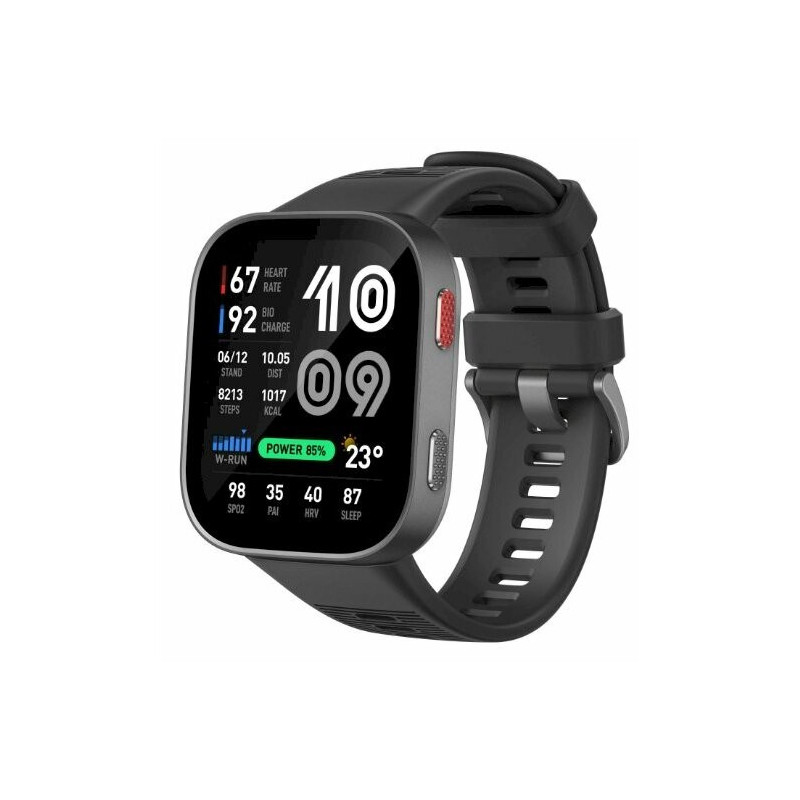
Amazfit's new watch promises 20-day battery life, a 3,000-nit screen and calls from your wrist — for around 100 euros.
Amazfit keeps expanding its popular Bip line, and the new Amazfit Bip Max is bigger, brighter and more durable than earlier models while staying at around 100 euros. Here is how it differs from its predecessors and who it suits best.
Display
The Bip Max gets a 2.07-inch AMOLED screen (432 × 514 pixels) with up to 3,000 nits of brightness — 50% brighter than the Amazfit Bip 6. That is more than enough to read the screen in direct sunlight. The front is protected by tempered glass with an anti-fingerprint coating, and an ambient light sensor adjusts brightness automatically.
Battery
The watch's biggest strength is its 550 mAh battery. Amazfit promises up to 20 days of typical use and about 10 days of heavy use. With GPS running, it lasts roughly 40–50 hours. That is far more than most Wear OS watches, which need charging every day.
Sport and health
The Bip Max carries a BioTracker 6.0 optical sensor that continuously measures heart rate, blood oxygen (SpO2) and stress. For workouts there are more than 150 sports modes, including HYROX and automatic recognition of strength exercises. Zepp Coach AI builds personal training plans, and advanced users can sync plans from TrainingPeaks or Runna and track VO2 Max and training load.
GPS and calls
The watch has five-system satellite navigation (GPS, GLONASS, Galileo, QZSS), and 4 GB of storage lets you load offline maps and music. Over Bluetooth 5.3 you can answer calls straight from your wrist — it has a microphone and speaker. Water resistance is rated at 5 ATM, so you can swim with it.
Who is it for?
The Bip Max is a great pick for anyone who wants a bright, long-lasting, affordable watch with GPS and calling without paying flagship prices. If you are after something even cheaper, take a look at the Xiaomi Redmi Watch 6 or the full range of Amazfit watches.
Price and availability
Globally the Bip Max costs about $99.99 (roughly 100 euros), or ₹10,999 in India. It launched in May–June 2026. The official price for the Baltic countries has not yet been announced, but it is likely to land around 100 euros.